Cameras to Bury Characters In
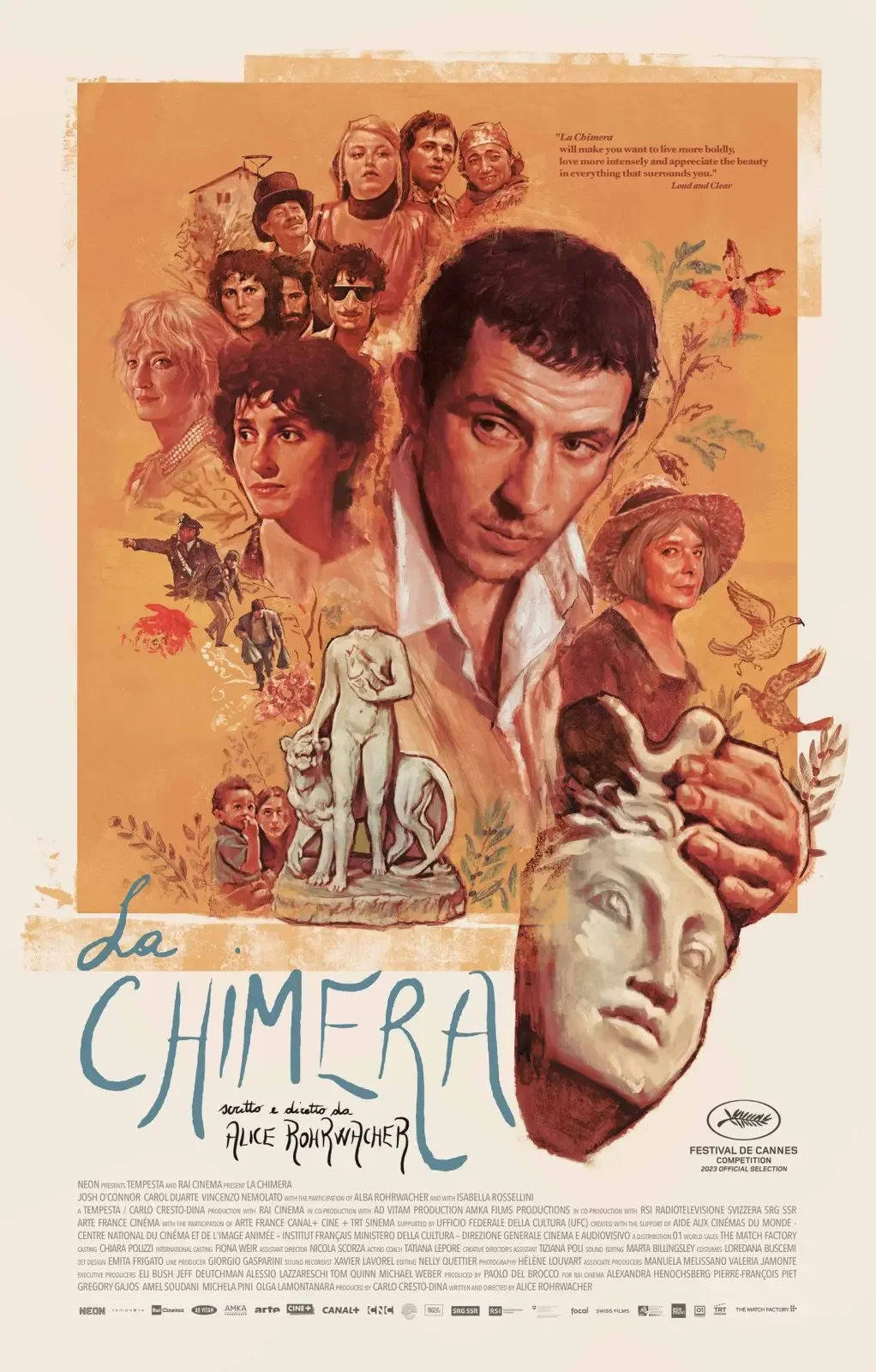
La Chimera, a film by Alice Rohrwacher
“In a stunning scene, Arthur’s twig-head tilts back toward him and the camera also dips and rotates to suddenly frame him upside down. It’s as if the word tool slowly revolves to become loot.”
In a climactic moment late in La Chimera, an art deal is conducted on a light-flooded paddle steamer. The steamer’s revolving paddlewheels echo the circular movement of film stock. Italian filmmaker and screenwriter Alice Rohrwacher subtly evokes an enormous floating camera! It’s a gorgeous piece of cinema—not obvious, but this is a film concerned with Italian cultural histories, cinema being one of them, and Rohrwacher’s meta-plays are numerous.
The opening scenes of La Chimera, the fourth film by Rohrwacher, foreshadow this desire to frame the mechanics of film. A young woman, who we later learn is the chimera Beniamina (Yile Yara Vianello), removes the camera’s lens cap—the camera we view the opening frames from—to reveal her pale face and shoulders blazing in the Tuscan sun. She then replaces the cap, and the screen goes dark and silent. We, the viewers, are trapped in a camera!
Cut to toffee-coloured light flooding a train carriage, painting the face of a sleeping man, Arthur (Josh O’Connor), who wears a cream-coloured linen suit. As the train moves and the sun peels from his face, he finds himself in this dreamy film.
In the camera-like carriage booth he finds three young Tuscan women and a dog. As Arthur sleepily observes, they appear to be incarnations of the Etruscan paintings he’s obsessed with. Striking features. Is he still dreaming?
Arthur is the reluctant hero of this 1980s-set folksong of a film. He is English and an ex-archaeologist returning to Tuscany after time in prison. He sheepishly leads a band of tombaroli (graverobbers). His girlfriend Beniamina is missing. Arthur will continue to recall or dream of Beniamina—sedated by these images—often in grainy handheld 16 mm (La Chimera is also shot, by Hélène Louvart, in Super 16 mm and 35 mm). Arthur’s face, through the film, is pinkish and putty pale, almost blank, weary, nearly clownish, sad.
After sleepy conversation with the giggly local women of the carriage booth, his aura of innocence is shattered when he roughs up a cheeky roving sock salesman. The Etruscan-like women flee, and the salesman follows, singing: “sock him in the face, buy my socks!” Then a rousing, ironic trumpet chorus arrives, and the rest of the train passengers peek at Arthur, this curiosity, from the carriage corridor before comically disappearing into their carriage booths. Cue opening credits.
Most of the scenes of La Chimera, a film that asks serious historical and political questions, contain a twist of this absurdist, almost-slapstick humour—it’s an elating narrative device.
Now that he’s back in town, the first thing Arthur does is visit Beniamina’s mother, Flora, a fading matriarch played by Isabella Rossellini. She lives in an enormous, dilapidated villa with peeling Etruscan-themed paintings on the walls—a metaphorical tomb. Flora has a live-in “singing student”, Italia (Carol Duarte), but appears to be using the “tone-deaf” Italia as a free housemaid. Italia, though, a Brazilian immigrant, is miraculously hiding a baby and a young girl in the old villa.
Italia is a beautifully comic character, all colour and innocence: shy, optimistic, absurd, communal. She whispers Brazilian Portuguese to her hidden children, and all this slowly charms Arthur.
Arthur’s cultivated sensitivities are gradually exploited by his grave-robber gang. A mucky troupe of moody, barking looters. One of them waits by the train to hit Arthur up immediately. They’re hilarious and needy. In the first of several funny silent-film-homage sped-up scenes, we watch Arthur in quick-stepping motion slapstick-wrestling the gang near a cactus.
Later, Arthur walks sullenly along a narrow, cobbled lane, while behind him, very slowly, a reddish-pink tractor carries his costumed robber-gang, dressed in drag—pure Fellini.
The ensemble cast’s movements appear to analogise Arthur’s legend. There are several people in almost every scene—Arthur can’t shake them; like sparrows they hover and twist, enacting the fable. But they cling to Arthur for his mysterious skill as a diviner. With a freshly plucked stick he can sense underground tombs containing Etruscan treasures, and his muddy, drunk funeral procession of robbers and diggers follow him into paddocks.
Given the film’s constant surfacing to the mechanics and history of filmmaking, I can’t help but think of Arthur’s divining stick as a symbol of the pen—electricity in the art of the myth. In a stunning scene, Arthur’s twig-head tilts back toward him and the camera also dips and rotates to suddenly frame him upside down.
It’s as if the word tool slowly revolves to become loot.
The cinematographic trick, surprising for the viewer, links the twig to the camera, to directions and the art of improvisation. Searching out the contour, the depths of the story itself.
(Arthur’s tool? A finger-length candle he keeps in his pocket, which he uses to illuminate tombs of terracotta owls and panthers and dancers.)
I’ve not yet mentioned the folk guitarist. At two points in the film, he sings the song of the film’s action over a montage of jerky sped-up motion—the gang on the run, unearthing skulls, rummaging in the earth. Arthur the hero teetering, as the song goes, “between bliss and the arcane”.
As much as La Chimera is tied up neatly, as a folksong should be, there are rewarding ambiguities to dig around in, particularly the task of siphoning reality from the dream.
Is the blossoming Italia a symbol of lost Etruscan ethics compared with the unscrupulousness around her? Perhaps the Etruscan-like sensitivities of Arthur and the sparkle of Italia speak for alternative historical trajectories? Does our Arthur seek Italia’s colourful commune of multicultural, aesthetic women—who, by the film’s end, run a refuge in an abandoned train station—or the self-serving status quo?
Most exquisitely of all, through the film’s tender final images, Rohrwacher maintains her meta-cinematic double play, uncannily calling to mind a pinhole camera.
La Chimera is a treasure.